

What is the ink drying time adjustment of a Tampography Machine?
Jan 22, 2026
Hey there! As a supplier of Tampography Machines, I often get asked about all sorts of technical aspects of these nifty devices. One of the most common questions I encounter is about the ink drying time adjustment of a Tampography Machine. So, let's dive right in and explore what this is all about.
First off, let's understand what a Tampography Machine is for those who might be new to the game. A Tampography Machine, also known as a pad printing machine, is used to transfer a 2D image onto a 3D object. It's super useful in a wide range of industries, from printing logos on Lego toys to adding designs on golf tees. You can check out our Lego Toys Tampography Machine or our Golf Tee Pad Printing Machine Automatic to see some real - world applications.
Now, let's talk about ink drying time. The ink drying time is the length of time it takes for the ink transferred by the Tampography Machine to dry on the surface of the object. This is a crucial factor because if the ink doesn't dry properly, it can smudge, get scratched off easily, or not adhere well to the object.
There are a few things that can affect the ink drying time. One of the main factors is the type of ink being used. Different inks have different drying properties. For example, solvent - based inks tend to dry faster than water - based inks. Solvent - based inks evaporate quickly, which speeds up the drying process. On the other hand, water - based inks are more environmentally friendly but can take a bit longer to dry because water evaporates more slowly.
The temperature and humidity of the printing environment also play a huge role. In a warm and dry environment, the ink will dry faster. Heat helps to speed up the evaporation of the solvents or water in the ink. So, if you're in a hot and dry climate, you might find that the ink dries much quicker than in a cool and humid place. For instance, if you try to print in a basement with high humidity, the drying time can be significantly extended.
The material of the object being printed on is another important consideration. Some materials, like plastics, can be more porous and absorb the ink better, which can affect the drying time. If the material is non - porous, like glass or metal, the ink might sit on the surface and dry differently. For example, ink on a glass surface might dry faster because it doesn't get absorbed into the material, but it also needs to adhere well to the smooth surface.
Now, let's get to the meat of the matter: how to adjust the ink drying time on a Tampography Machine. Most modern Tampography Machines come with some built - in features to control the drying process. One common method is using a heat source. Some machines have a built - in heater that can be adjusted to different temperatures. By increasing the temperature, you can speed up the drying time. However, you need to be careful not to set the temperature too high, as this can damage the object being printed on or cause the ink to bubble.
Another way to adjust the drying time is by using a fan. A fan can help to increase the air circulation around the printed object, which in turn speeds up the evaporation of the ink. You can adjust the speed of the fan to control how quickly the ink dries. Some machines even have adjustable fans that can direct the airflow precisely where it's needed.
You can also play around with the ink itself. Some inks come with additives that can speed up or slow down the drying process. For example, there are drying agents that you can add to the ink to make it dry faster. But again, you need to follow the manufacturer's instructions carefully when using these additives, as using too much or too little can affect the quality of the print.
Let's talk about the importance of getting the ink drying time just right. If the ink dries too quickly, it might not transfer evenly onto the object. The ink could start to dry on the pad before it's fully transferred, leading to a patchy or incomplete print. On the other hand, if the ink dries too slowly, it can cause smudging and misalignment. The object might move before the ink is dry, ruining the print.
In the industrial setting, getting the ink drying time accurate is crucial for maintaining high - quality standards and increasing production efficiency. For example, in a factory that produces thousands of buttons a day, using our Automatic Buttons Ink Cups Pad Printing Machine, the right ink drying time ensures that each button has a perfect print and can be quickly moved along the production line.

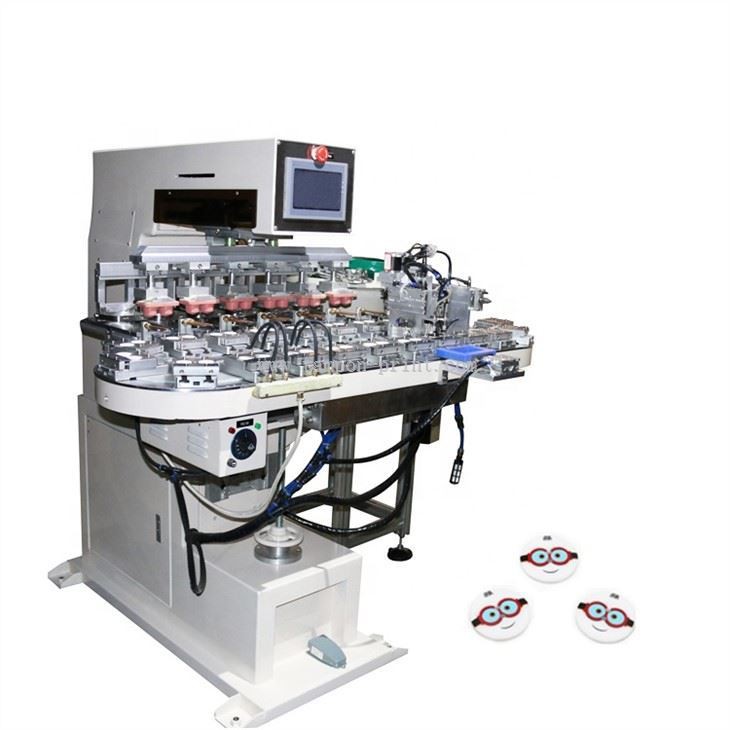
As a Tampography Machine supplier, we understand that every customer has different needs when it comes to ink drying time. That's why we offer machines with a wide range of adjustable features. Whether you're a small - scale operation looking to print a few custom items or a large - scale factory with high - volume production, we can help you find the right settings for your ink drying time.
So, if you're in the market for a Tampography Machine or want to learn more about optimizing the ink drying time for your specific application, don't hesitate to reach out. We're here to answer all your questions and help you get the best results from your printing projects. Let's start a conversation and see how we can meet your printing needs!
References
- General knowledge of pad printing technology from industry experience
- Manufacturer's manuals of Tampography Machines